 Golden Retriever
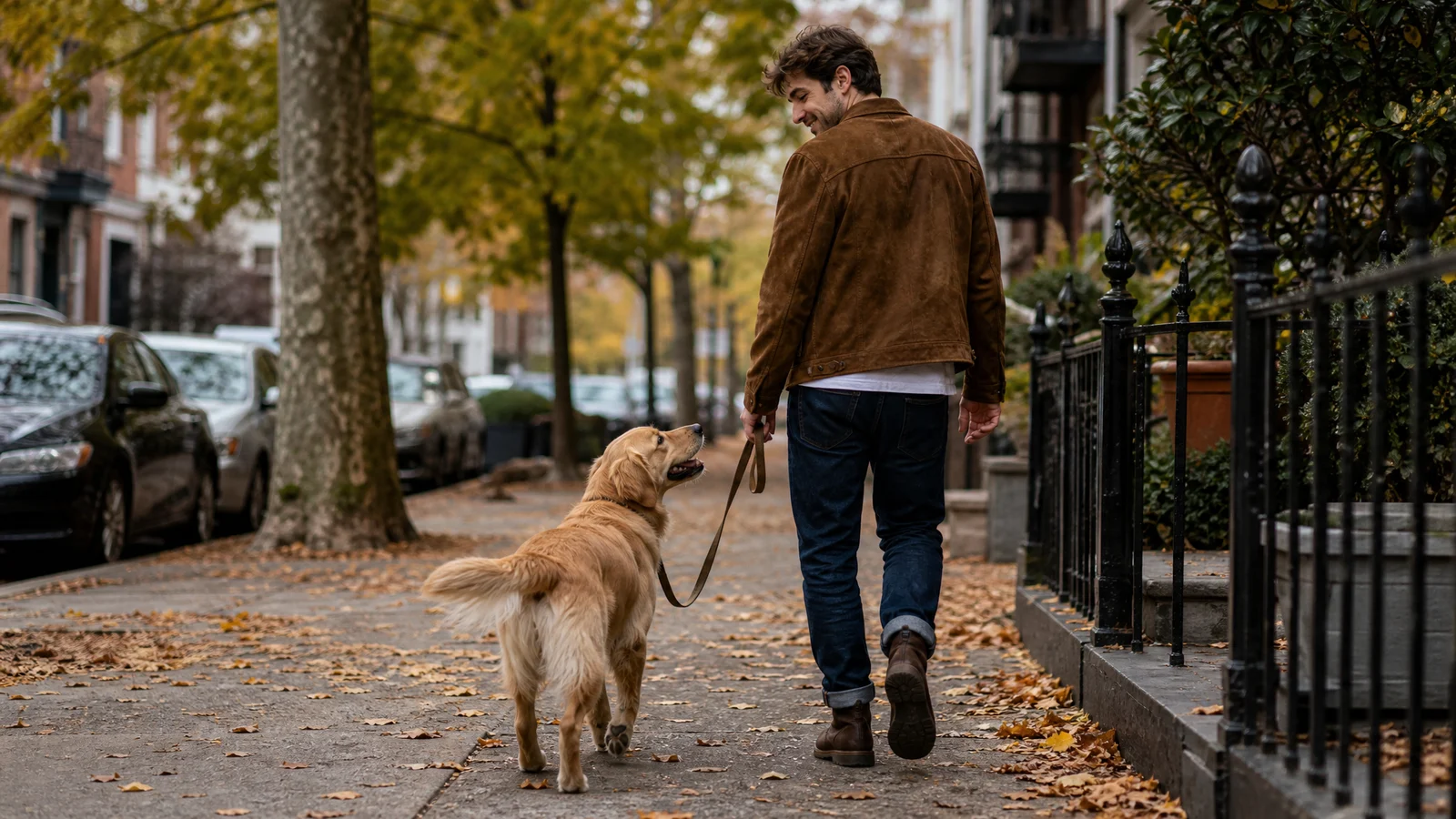
Start leash work in the first weeks you have your Golden, and aim for a solid loose leash before the teenage months. A Golden stays mentally young while the body heads toward 70 pounds, so a puppy who learns that pulling pays becomes a teenager who pulls with nearly 70 pounds behind them.
Owners report that the pulling is rarely constant. It switches on at a strong scent, a stranger who might pet them, or another dog across the road. That is why a dog can walk beautifully in the living room and feel like a different animal outside. We have trained this breed for many years, and we build the work around those triggers.
Below, you'll find how to introduce the gear, the quiet-place steps, and plans for scents and greetings, including what to do when the teenage months undo your progress.
Golden Retriever Leash Training Before Adolescence
Owners who describe the hardest walks tend to describe the same two stretches. One is a puppy of 4 to 9 months hauling toward every smell. The other is an adolescent of one to one and a half years doing the same with far more muscle. Some talk about arms nearly pulled out of the socket, or walks they have begun to dread.
The cause is a mismatch. A Golden is a mentally young dog in a body that reaches 55 to 75 pounds, so a puppy can be strong and sizeable long before they understand any rules. At three to five months they are big enough to knock you down but not old enough to know they shouldn't. Lean on management (a leash, a gate, a drag line) as much as on training.
Why Waiting for Calm Fails
This is why we push back on the advice to wait until your puppy is calm enough to learn. A young Golden will not be calm on any schedule you can plan around, so begin with short, happy sessions now. Owners report that loose-leash walking clicks on very different timelines: the first sessions at 10 weeks for some, about five months of daily work for others, and three or four years for a few.
The effort pays back twice, because brisk walks on leash are one of this breed's main outlets. A pleasant walk doubles as the exercise your Golden needs, while a tug-of-war walk shortens the outing and leaves a dog with more energy to spend.
Getting Used to the Harness and Leash
Gear is where owners disagree most. Many describe a front-clip harness as the biggest single change in their walks, sometimes from the first outing, and a chest clip beat a back clip for scent-driven pullers. Others watched their Golden pull straight through the same harness or drift back to old habits after a few weeks. Some found a back-clip harness turned their dog into a sled dog.
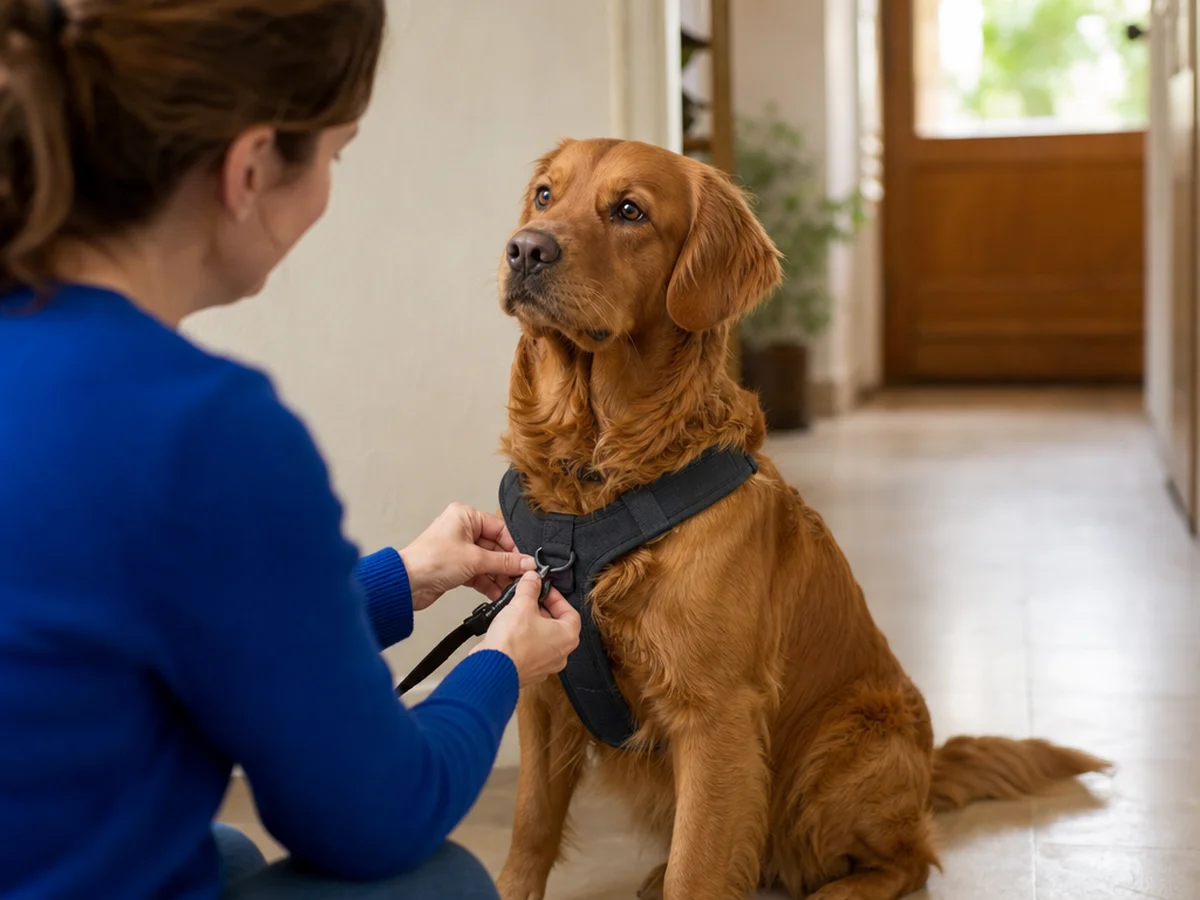
Our view is that a harness is a steering aid that buys you time while training does the real work. Introduce it with a treat for every step: harness out, treat, harness over the head, treat, buckle, treat. Let the puppy wear it for short stretches during meals and play before it goes anywhere near the street.
Starting With a Trailing Leash
From 9 to 12 weeks, a light leash or a 10–15 foot line trailing around the house or yard is a gentle introduction. Once they ignore it, take hold of the handle and stroll behind them, so they learn that your hand on the leash just means you are moving together. There is no need to insist on direction yet.
Some dogs resist new gear at first, and many Goldens dislike a head halter in particular, pawing at it or sitting down to refuse it. Keep sessions short and pay well. By three to five months the goal is a puppy who understands the leash is not there to restrain them, only to keep them safe, and who stands on a loose leash and looks at you when you speak. Fit decides whether any of this works, so check these points:
- Chest straps that gape let the harness shift and invite a dog to pull straight through it, so adjust until it stays put when they lean forward.
- Recheck the fit as the puppy grows, because puppies grow and some owners had to size up.
- Look under the front legs after walks, since loose or badly placed straps can rub the armpits raw.
- If a harness keeps loosening or slipping over the head, owners solved it by readjusting the straps or changing brands.
Many Goldens also grab, mouth and carry the leash, especially when excited. Owners say handing the dog something to carry, such as a toy, ended the leash biting for theirs.
Loose-Leash Steps Indoors and in the Yard
Several owners report a Golden who heels perfectly at home or in the yard and loses every bit of it at the front gate. That is not stubbornness. Dogs are situational, meaning a skill learned in one place does not automatically work in another. So we build loose-leash walking in layers, starting where nothing competes with you.
Two terms first. A loose leash hangs in a gentle curve with no tension. A marker is the word you say at the instant of success, such as yes, telling the dog that exact moment earned a treat. Use small, soft treats that go down fast, and move at a brisk pace, which many owners find holds a Golden's attention better than a stroll. Stay at each step until the dog succeeds most of the time.
- Indoors, mark and treat each time the dog looks at you with the leash on. If they walk beside you without looking, walk on in silence.
- Take a step and mark when the dog is beside you, delivering the treat at your leg. Build to a lap around the room.
- When the dog drifts ahead, turn the other way, then mark and reward as they turn with you.
- If the leash goes tight anyway, stop walking when they pull and wait for slack, then move on.
- Repeat the same steps in the yard, then on a quiet sidewalk, going back to frequent treats in each new place.
Stopping and standing still gets mixed results. Some owners got there with consistency, while others stopped again and again with little change, or ended up with a dog who learned to pull and then come back. If that sounds familiar, mark before the leash tightens and let moving forward be the reward. The principle underneath is that not pulling is the fastest route to wherever the dog wants to go.
Add release words for sniffing and potty breaks, so the dog learns that a loose leash earns those things too. It is perfectly fine to stop and let a puppy investigate, walking slowly as you would with a young child.
Why a Golden Retriever Pulls at Scents
Owners say a scent can lock a Golden's nose on and beat any treat you offer. Blowing leaves, the road to the park, the urge to potty and the first five minutes out of the door are all common flashpoints. Days without a structured walk make it worse. Several of these owners find the same dog is flawless at home.
A Golden's nose works like a news feed that never stops updating. Each smell is a message the dog has to read, and asking them to ignore it for a cookie is like asking you to ignore a buzzing phone. Resistance rarely wins, so give the reading a place in the walk.
Plan the First Minutes
Let the start of the outing serve the dog's needs. Walk to a potty spot, give the release word and let them sniff. Then ask for a loose leash with a brisk pace and kibble at your leg, rather than hot dogs, which slow the rhythm down.
Handle the Nose-Down Moment
When the nose locks on mid-walk, turn and move away before the leash tightens. Once it is slack, release them to sniff at a good spot with a cue like go sniff, so the smell becomes the reward for walking nicely instead of the thing that breaks it. Scattering a few treats on the ground also resets focus, and sniffing games at home give a strong-nosed breed a legitimate outlet.
Greeting People and Dogs on Leash Without Lunging
Many owners describe a friendly young Golden who would run up to greet every human who might pet them. Teenagers can lose all focus around people and dogs, ignoring even high-value treats, shaking, jumping on visitors or pulling the owner over. Most of this is eagerness, not fear. In this breed, pulling toward people and dogs is usually about saying hello.
The key term is threshold: the closest you can get to a person or dog while your Golden still takes a treat and thinks. Closer than that, no cue registers, so your first job is to find where that line sits.
Greeting People
Catch the moment the dog spots someone, when the head comes up. Mark that glance, feed, and turn to put distance between you. Allow a hello only when the leash is loose, using a release word such as go say hello so the greeting becomes the reward for calm. Some owners get results from a tug game whenever someone approaches. Early socialization should teach that people are ordinary, not a party.
Passing Other Dogs
Use the same distance and the same turn-away. The typical Golden is friendly to everyone, but a minority of owners describe dogs who love people yet snarl or lunge at other dogs, often only on leash or after being attacked. That can be leash frustration, which is a different problem from eager pulling.
If you see growling or snarling, add more distance and bring in a qualified, reward-based professional. Other owners whose dogs were bitten at parks say their dog still loved dogs afterward, so do not assume the worst. A few Goldens simply sit and watch people and dogs go by.
When Teenage Months Test Your Golden Retriever
Some puppies walk nicely at a young age and lose it at around seven months. Others start a new phase of pulling at a year. If this is your Golden, nothing is wrong with your training. The body is big and strong, the brain is still young, and the distractions have multiplied.
Why the Habit Slips
Owners say leash manners and impulse control came with age as much as with any single method, and that it may take two years. Still, these months are when training matters most, and it should be well engrained by 18–24 months. Keep working on the leash, but accept that your Golden will make many errors.
Rebuilding the Habit
Go back a level. Return to the quiet yard, reward every few steps again, and check that the harness still fits. Some owners only made progress when they rewarded every 10 steps. Mouthiness lasts beyond teething, so keep leave it and drop it in practice and give your Golden something to carry.
Meet the exercise needs of this age with swimming, ball play, play dates with known safe dogs and scent work. Schedule regular vet visits as well, and have a dog who suddenly lags or resists walking checked for pain. Owners split on gear. Some weaned off the harness within weeks, while others keep it for life as a control tool on multi-dog walks.
Questions That Follow a Loose Leash
Goldens are friendly, mentally young dogs in strong bodies, and that explains most of what goes wrong on a leash. They pull toward what they love. The remedy is to make the walk itself worth staying for: start in the first weeks, practice in quiet places, treat scents and greetings as the real exam, and expect the teen months to test you. Keep rewarding the choice to stay with you.
Once the leash feels easier, a few further questions usually come up for Golden owners:
- Will your Golden come back when called once the leash comes off? Start with Golden Retriever recall and off-leash training.
- Is a stubborn walker a slow learner? Read how smart Goldens are.
- Why is the breed so friendly with everyone, and what if yours is not? See Golden Retriever temperament and personality.
 BehaviorWhen Do Golden Retrievers Calm Down?
 BehaviorTeaching a Golden Retriever to Greet Guests With Four Paws Down
 BehaviorGolden Retriever Puppy Chewing Everything? Teach Leave It