 Golden Retriever
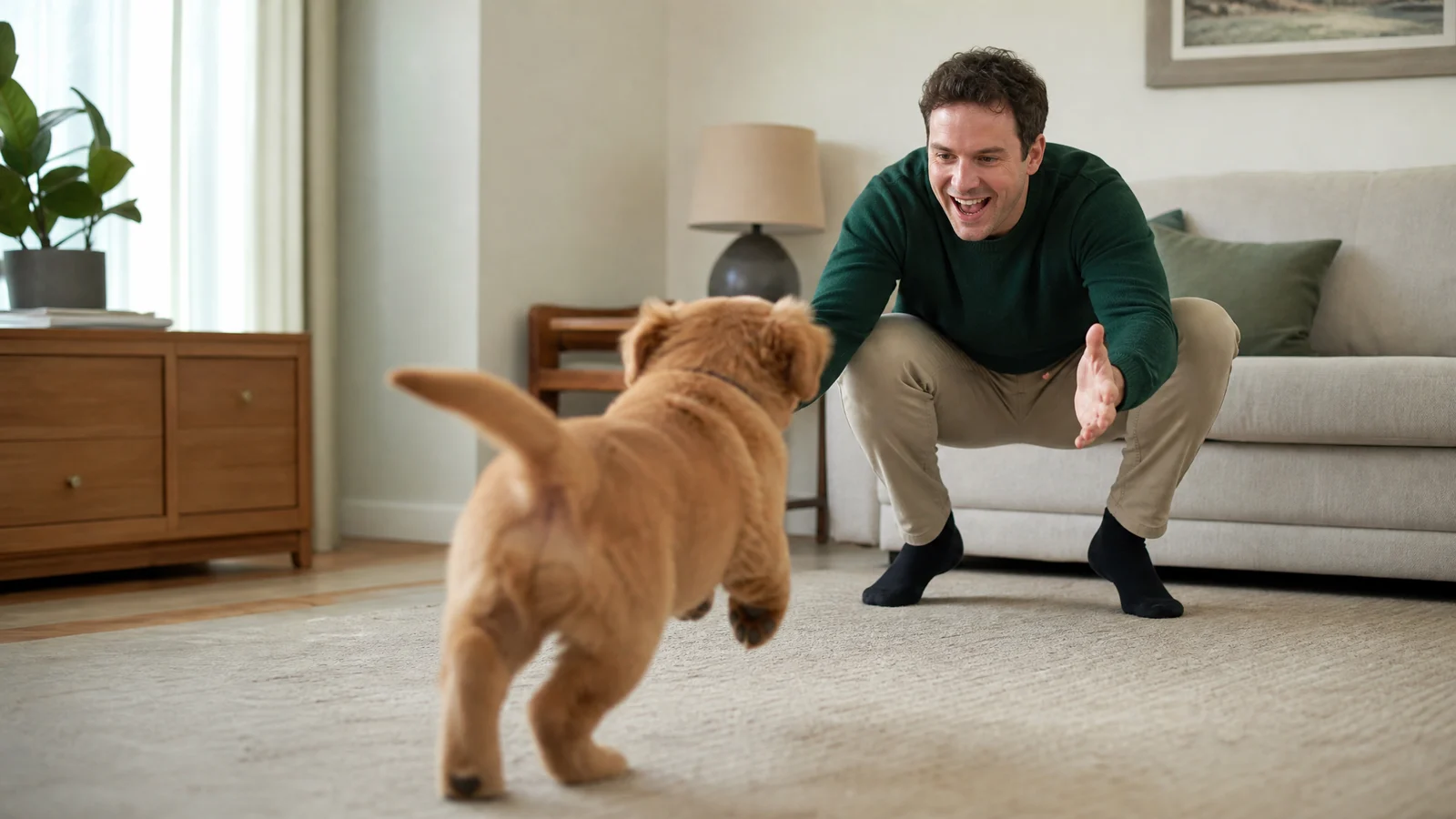
Experienced Golden breeders have observed that owners over-prepare for the baby months and badly under-prepare for the teenage ones, which last much longer. The habits arrive before the lessons do, and a Golden's size arrives with them. The fix is to start small on day one, a few minutes at a time, and to follow a calendar built for a breed that takes about two years to grow up.
We have trained this breed for many years, and the calm adults come from early habits, not from outgrowing things. Done right, these months give you a gentle, tuned-in dog, and done badly they give you a teenager heavy enough to pull you over.
We'll walk you through day one, the early socialization window and the first cues to teach, then the owner-reported spread in milestones, the second fear stage, the teenage months and what year two still asks of you.
Starting Puppy Training on Day One
Training begins the day your puppy walks in, and for most families that is somewhere between seven and nine weeks. Goldens mature at roughly one month of puppy life to one child year for the first 24 months, which makes a new arrival comparable to a toddler, so lessons stay tiny and management stays generous. Keep shoes up and trash behind a cabinet door, and see our guide to the first week home for the setup.
Then diagnose the first day. If your puppy sleeps almost nonstop, let them, since many owners see a livelier puppy by that night or the next day. If crying starts in the crate within minutes, set the crate next to your bed and rest your fingers at the door. Most puppies settle within one to four nights, and a few take three to four weeks.
This is general information, so check with your veterinarian before any medicine or diet change.
Potty Trips and Tiny Sessions
Between naps, take the puppy out at every change of activity, meaning after waking, after play and after eating, and at first about every 15 minutes while awake, as our Golden Retriever potty training guide lays out. Add a few tiny sessions a day: say their name and treat, touch a paw, reward a sit. If a session runs past a few minutes or the puppy starts chewing your sleeves, you overshot, so stop and let them nap.
Treat the calendar as the plan. The development road map names an Angel Phase from 2 to 6 months, a Teenage Rebellion Phase from 6 to 18 months and a Signs of Maturity Phase from 18 to 24 months. Every goal for the adult dog, from coming when called to settling away from the family, starts as a tiny habit now. So begin right away, with short, simple sessions.
Socializing a Puppy Before the First Fear Stage
From seven weeks to four months, gentle exposure to all kinds of people, places and situations is what shapes a well-mannered adult, and two to four months is the critical stretch within it. Goldens are typically friendly to everyone, so the usual problem is greeting manners, not shyness. Your first socialization goal is a puppy who meets people calmly, not one who launches at every stranger.
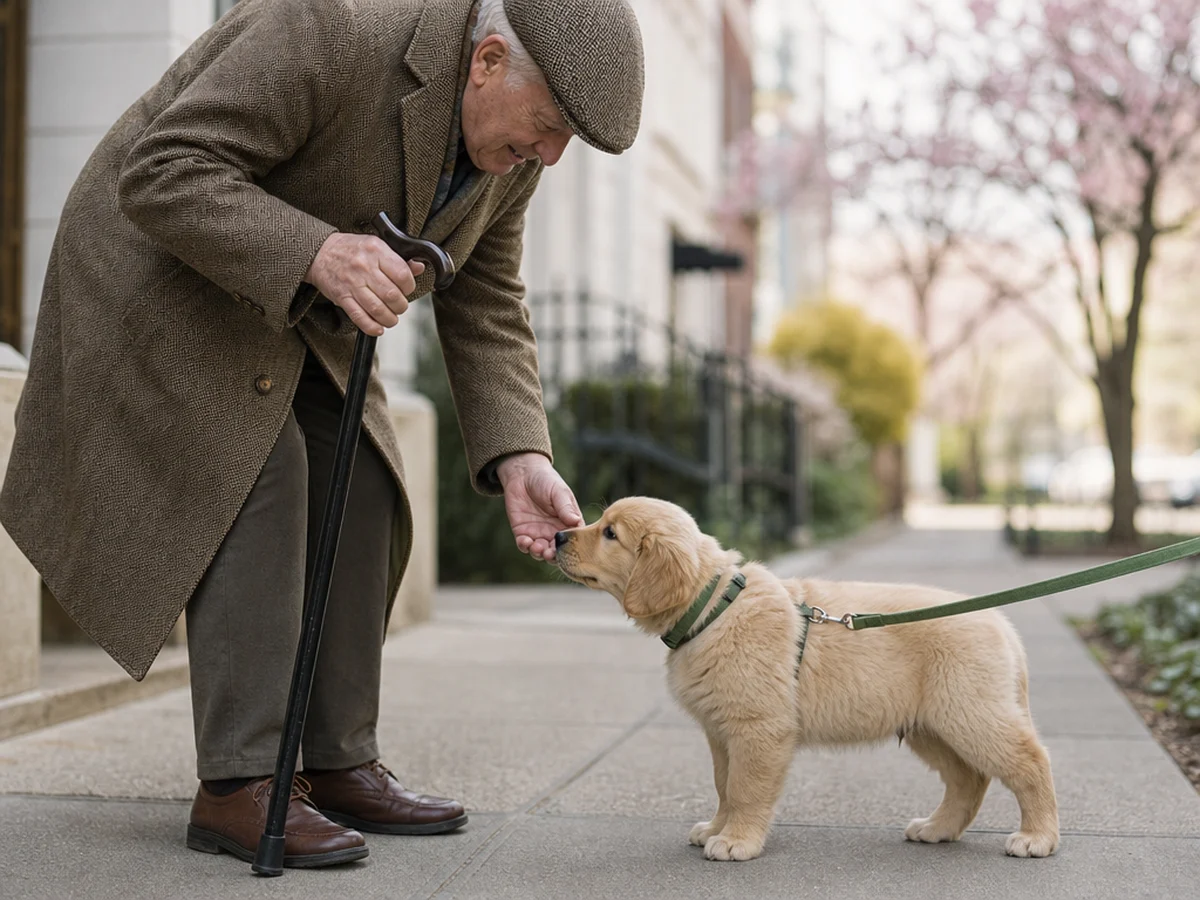
A fear stage sits inside this window. Somewhere around 8 to 11 weeks, puppies can hit normal fear periods, and the breeders place another fear stage in the 2 to 6 month Angel Phase. If a bold puppy backs away from something familiar or startles at a thing they ignored last week, read it as a stage and not as their personality.
Then decide by what the puppy does. If they hesitate, stop moving forward, let them look from where they feel safe, and feed treats while the scary thing stays still or far away. If they approach on their own, praise calmly, and if they do not, leave without fuss and try again from farther back.
A controlled outing in this window follows a few rules:
- Pick one new thing per outing, such as a person on a bench or a different floor surface, and end while the puppy is still curious.
- Ask your vet which places are safe while vaccines finish, and carry the puppy or keep them close. Owners who started classes at 8 to 12 weeks and skipped dog parks and pet stores report friendly, confident dogs.
- Reward four paws on the floor and a sit whenever people say hello, so manners grow alongside friendliness.
- Cut the number of new things per day, not raise it, during a fear patch.
Skipping the work is the bigger risk, because improper socialization in this window raises the chance of later fear, avoidance and aggression. If a puppy stays quiet, hides or refuses food beyond the first days, call your vet and then a reward-based professional, since timidity falls outside Golden character. Some quiet starters do come out of their shell by about 4 months. So choose calm, controlled exposure over crowded outings.
First Cues for a Golden Retriever Puppy
Eager to please is the Golden's advantage, and it tempts owners to teach six cues in a week. A puppy of three to five months can learn many commands and is still a puppy, whose antics will wear on you if you let them. Pick the order by what each cue fixes, and add the next one only when the last one works.
If the puppy ignores their name, stay on that step. Otherwise the starter set runs in this order:
- Their name comes first, said once and followed by a treat every time, because every other cue needs the puppy's attention.
- Sit comes second, because it replaces jumping and gives a friendly Golden something to do when people say hello.
- Come is third: call, back away and reward at your knees, never calling for something unpleasant. If the puppy grabs a forbidden item and runs, trade for a treat instead of chasing, because a chase teaches keep-away fast.
- Settle is fourth: reward lying down on a mat or in the crate with a chew after play, since a calm Golden on the couch at night comes from meeting their needs every day.
Proof each cue in several places before calling it learned. Dogs are situational, so a sit that works in the kitchen can vanish in the yard or on the street. If a cue falls apart, lower the difficulty and pay well rather than repeating it louder, and accept that even a good puppy makes many errors.
Hold leave it, drop it and give until the starter four hold, then keep them in training well into adolescence, because a Golden's need to have something in the mouth outlasts teething. Puppy kindergarten with a skilled instructor helps, since classes teach you how to interact with and train the puppy. The chosen starter set is name, sit, come and settle.
Reading Golden Retriever Puppy Milestones Early or Late
Every milestone has a spread, and the spread is wide enough that a puppy can look late on one and early on the next. The table gathers where owners place each one, so you can see whether yours sits inside the usual band or out at an edge.
| Milestone | Where owners place it | The wide end |
|---|---|---|
| Constant biting ends | Mostly 4 to 7 months | Over by 12 weeks in some, back again at 20 months in others |
| Baby teeth lost | About 4 to 5 months | Still coming out at about 5 months |
| Weight at 6 months | Most around 38 to 45 pounds | 30 to 54 pounds |
| Loose-leash walking clicks | First sessions to about 5 months, with daily work | 3 or 4 years, with some still working on it at 8 |
| Teenage phase | Most often 7 to 11 months | 6 to about 18 months, lasting two months to almost 3 years |
| Calming down | About 2 to 3 years | 3 months to 13 years, and some not by 10 |
Read your puppy against the table with one rule. If they sit outside the band but are eating, engaged with you and recovering from scares, keep the daily reps going. Vets have called six-month-olds of 30 and 38 pounds fine, and the breeders' adult targets run 55 to 65 pounds for females and 65 to 75 for males.
Owners who have raised several Goldens say each one calmed at a different age, so one dog's timeline predicts little about the next. The reverse also happens: a minority of owners describe a mild teenager or none at all, and an easygoing puppy at 5 months does not guarantee an easy adolescent. If yours is easy, keep practicing, because the habits still need building.
Coat changes run on their own clock too. Many owners are surprised when the adult coat arrives first as a stripe down the back over fluffy puppy fur on the sides, with a heavy first shed, so an awkward-looking adolescent is a stage, not a problem. Keep regular vet visits going to track growth, note where your puppy sits against the table, and then neither panic nor compare.
The Second Fear Stage in a Teenage Puppy
Expect a second fear stage inside the teenage phase, so socialization restarts here instead of ending at four months. The teen years may start anywhere from six to 12 months and finish between 18 and 24 months, as hormones surge and the brain rewires. The breeders say the coping skills learned earlier are what prevent permanent fear behaviors this time.
Telling Fear From Testing
If a teen who walked past something for months now spooks, freezes or barks at it, treat it as fear. Add distance, feed treats while they look, and never make them greet. If they know a cue and ignore it, that is testing, which the next section covers, and the answer there is a lower difficulty instead of more distance.
Preferences and Hormones
Adolescent Goldens develop dog preferences. Common advice sends a teenager to the dog park to burn energy and make friends, but like children they have favorites, so respect their choices and arrange a few known, easy playmates instead.
Hormones add wobbles. Intact males can show leg-lifting, marking and growling or scuffles around 6 to 9 months, and females usually have one or two heats before 18 months, so plan classes around them. Whatever you see, back off pressure and keep feeding, walking, nap and training times steady, because routine is what a wobbly teenager leans on.
Holding the Line Through Your Puppy's Teenage Months
Selective hearing is the mark of this phase. Owners place it anywhere from 6 to about 18 months, most often at 7 to 11 months, and describe a dog who knows the cues and ignores them when it matters, perfect in a quiet room and lost around people. Breeders note that owners over-prepare for the baby months and underprepare for the teens, which last much longer.
Chewing peaks in the same window and reaches the house itself, with baseboards, drywall, door trim and carpet going, often despite piles of chew toys and daily walks. Size raises the stakes, since owners report dogs of 70 to 80 pounds at 8 to 10 months who can pull an adult over. Management carries the load: dog-proofed rooms, a gated kitchen, a house leash, and a crate or pen after a bad day.
Match your response to what you actually see:
- If they ignore a cue they know, make it easier, pay better and ask again somewhere quieter.
- If they destroy things only when you are home but busy, give a chew and keep them in a crate or pen in the room with you.
- If puppy habits come back, such as greeting nips, nippy zoomies or pulling, return to a smaller area for a while, and see our Golden Retriever puppy biting guide for the mouth side.
- If a crazed wave hits, turn away, ask for a minute of sit-down-stay or give a crate nap, since frustration makes it worse.
Expect regressions even in a dog who earned trust. A sudden bad dog day of destruction can follow new freedom, and many owners hold off on free run of the house until about 2. More exercise paired with more training improved behavior for many owners.
Keep sessions short and the rules identical for everyone in the household. Many owners who got through the year report a polite, gentle adult who backs off sooner when told, even if the year was hard enough to make them question getting a puppy. So hold the line with consistent rules and short sessions, and let time do its share.
Why a Two-Year-Old Golden Retriever Still Needs Practice
Between 18 and 24 months the personality comes into full bloom, and it may have gone underground during adolescence. Growth is mostly finished by two, though males may take another year to finish, especially in the head, so this is when adult routines and impact work begin. Training shifts from learning to upkeep, and the breed stays playful and silly well into adulthood.
Upkeep means re-proofing, not reteaching. Test recall past the distractions that beat your dog as a teenager, and keep loose-leash walking in the plan, since it clicks on very different timelines and several owners are still working on it in adult dogs. Freedom while you are out usually comes after the first birthday.
That is the point of the calendar. The timeline is a range, not a deadline, and steady practice matters more than speed. A Golden who is still wild at a year or two can settle later, and the calm comes from daily exercise, mental work and company, not from waiting.
For the next two weeks, keep it small:
- Run three five-minute sessions a day, using the starter four or the next cue on your list.
- Add one new social experience, calm and controlled, at a distance your puppy handles.
- Write one note on where your puppy sits against the milestone table, so you have a reference when the next phase arrives.
Then repeat, because a slow-maturing breed rewards patient owners. For the wider picture, our complete Golden Retriever training guide picks up where this calendar leaves off.
 Training basicsGolden Retriever Training: The Complete Guide for Owners
 Training basicsGolden Retrievers and Kids: What to Expect and What to Train
 Exercise and jobsHow Much Exercise Does a Golden Retriever Need? Plus Brain Games