 Golden Retriever

To reduce Golden Retriever barking, identify the context first, prevent the easiest rehearsals and reward an alternative the dog can already perform. One quiet cue cannot solve alert barking, requests for access, vocalizing during absence and distress as though they were the same problem.
The practical question is what happened before the sound, what the household did next and how the dog recovered. Below, we sort those observations, change predictable setups and give a reward-based method for a mild trigger. Sudden changes, possible discomfort and escalating distress belong with veterinary or qualified behavior help rather than a home quiet exercise.
What Sets Off the Golden Retriever Barking?
Start with one setting. The ASPCA outlines barking functions, so describe the context before choosing a plan. Record the location, preceding event, movement and return to ordinary activity.
Include the moment before the dog noticed anything. A latch, footsteps, a departure or the end of play may matter more than volume. Note whether the dog can look away and resume an ordinary activity.
| Observed Context | First Response to Check | Topic Owner |
|---|---|---|
| Movement appears through a window | Limit the sightline ahead of predictable traffic | This barking plan |
| Barking starts when interaction stops | Check whether attention follows the sound | This barking plan |
| Vocalizing occurs only after departure | Observe absence behavior without extending distress | Alone-time owner page |
| Body becomes tense and recovery slows | Create distance and stop the practice | Individual support plan |
| A new pattern appears with a daily change | Arrange veterinary assessment | Veterinary care |
Route the context before choosing a cue. The table cannot identify a cause. Keep separate notes for separate settings so an easy window adjustment does not obscure a harder absence pattern.
Observe what follows the household response too. Barking that reliably opens a door or starts play may persist because it changes access. A brief alert followed by a return to rest has a different shape. Describe those outcomes without assigning intent that the sequence cannot prove.
If barking occurs only when everyone leaves, use the existing Golden Retriever alone time guide for the recording and comfort sequence. This page does not repeat that work. Here, absence is a boundary that prevents an ordinary trigger exercise from being applied to possible separation distress.
Change the Rehearsal Before Teaching Quiet
A dog who reaches the same trigger repeatedly practices the entire route from noticing to barking. Change access before asking for a quieter response. The adjustment should still leave a comfortable place to rest, move away or engage with an appropriate activity.
Window Views
Block the clearest sightline before predictable foot or delivery traffic begins. Move the resting place away from the glass and keep a route open to a quieter area. Closing a blind after a long barking episode may end that event, but it did not prevent the repeated approach that made the response harder to interrupt.
Notice whether sound, reflection or movement remains after the view changes. If the dog still rushes to the same spot, the original explanation may be incomplete. Restore the easier setup and change only one feature when you next observe the pattern.
Prepare the destination as carefully as the barrier. A bed behind the same window offers little relief, while a calmer area with water and a familiar activity gives the dog somewhere practical to go. Reward ordinary use of that area when no trigger is present so it does not predict only a noisy event.
Activity Gaps
The RSPCA barking guidance notes that boredom can contribute when dogs lack suitable activity, things to do or company. Meet ordinary needs with a balanced routine, appropriate play, rest and social contact. Do not assume that every vocal episode is a request for more exercise.
Plan attention before a familiar demand-barking period rather than waiting for noise to start the interaction. Reward calm approaches, settling close to the household or choosing a suitable toy. If barking has already begun, avoid turning the moment into an excited conversation and guide the dog toward an easy, previously taught option.
Exercise can support a good day without serving as a cure. PDSA's exercise guidance cautions that activity may help without fixing unwanted behavior, and a busy setting can increase stress for a dog who is already struggling. Match activity to the dog rather than trying to exhaust barking away.
Protect rest as part of the routine. A dog who moves from one stimulating event to another may have difficulty settling even when plenty has happened. Offer a predictable quiet period and notice whether the barking context changes, while keeping health or distress questions separate from a simple activity adjustment.
Schedule quiet enrichment before the familiar gap and finish it while the setting is calm. If the dog abandons it to monitor the trigger, present fewer items. Reduce the trigger and restore an easier choice. The aim is a workable routine, not constant entertainment or an effort to occupy every minute.
Teach a Useful Alternative to Barking
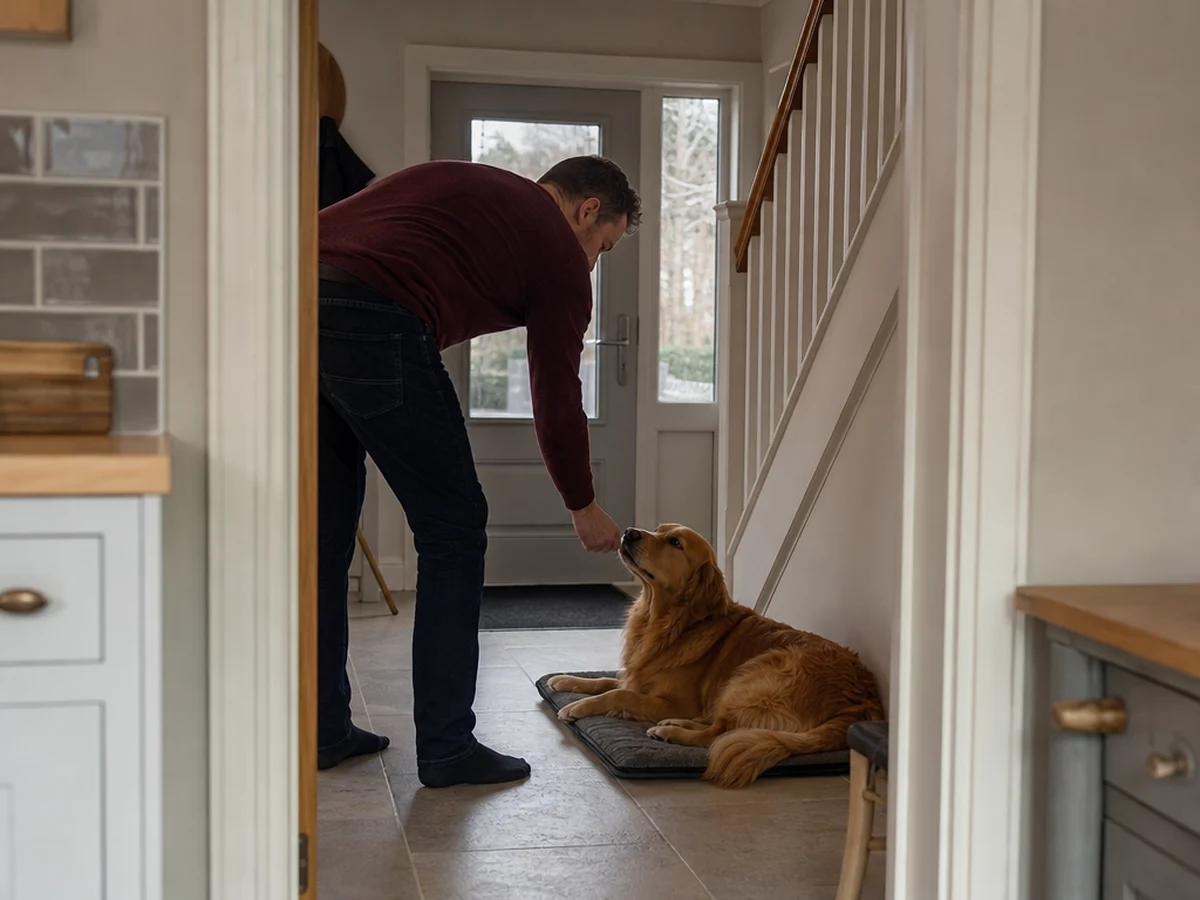
Use this method only when the trigger can remain mild and the dog can eat, move and respond. Choose one already known alternative that fits the setting, such as moving to a bed, turning to the handler or carrying a suitable toy.
- Set up a reduced version of the trigger while the dog remains loose enough to notice and disengage.
- Interrupt the route early by inviting the already known alternative before barking gathers momentum.
- Mark the completed alternative and deliver a valued reward at the chosen finish location.
- End or simplify the exposure if watching becomes fixed, movement tightens or the alternative disappears.
- Write down the setup, response and recovery before changing the next practice.
Deliver the reward where the alternative should finish. Sending food toward a window can return the dog to the trigger, while delivery at the resting place supports movement away.
Add a quiet cue only after the alternative is predictable in the easy setup. Say it once before the expected movement, then reward the action. Repeating a word over sustained barking makes the cue part of the noise.
If the dog can perform the action before a trigger but loses it as soon as one appears, the setup is too hard. Increase distance, reduce the view or return to management. Do not hold the dog in place, block their exit or keep adding cues until they comply.
A cue is one useful tool, not a complete explanation. The DACVB behavior-care guidance distinguishes obedience training from care for a behavior's underlying cause. If the dog cannot recover, safe management is difficult or distress spans many settings, a repeated quiet cue is not an adequate plan.
Golden Retriever Attention and Quiet
Some Goldens are observant and may notice activity around the home, while others are quieter. Neither description predicts this dog's response. Use the trigger record to decide whether the dog is alerting briefly, seeking an outcome or having difficulty returning to ordinary behavior.
Social attention can be useful when it is offered before a demand cycle and attached to a calm choice. Greet a quiet approach, begin planned play on a household schedule and reward settling where daily life happens. Do not withhold all affection in an attempt to make the dog independent or wait for frustration before offering an appropriate activity.
A carrying option may suit an individual Golden who already enjoys moving with a toy, but it is not required and it does not explain the barking. Offer only a suitable object the dog handles safely. The training target remains movement away from the trigger and an easier return to normal activity.
Keep household responses specific to the context. A person handling the window should restore the visual barrier, while someone else can make the resting area ready. Several people calling, touching or producing rewards at once can increase excitement and make it unclear which action earned the outcome.
Notice quiet choices outside formal practice. A Golden who checks a sound and returns to resting has offered useful information about recovery. Calm acknowledgment and a reward can strengthen that choice without creating a rule that every ordinary sound must start a training session.
When Barking Needs Professional Help
Pause the manageable-trigger method when barking changes suddenly, accompanies possible discomfort or occurs with altered movement, appetite, rest or touch tolerance. Keep up with routine veterinary care and schedule an assessment for a new or concerning pattern. Do not keep recreating the trigger while a health question is unresolved.
Escalating distress, attempts to escape, inability to settle and behavior that creates bite or injury risk need individualized help. Increase distance and use practical barriers without cornering the dog. A qualified professional can assess the complete setting and build a plan that a general article cannot safely provide.
Management remains useful while help is arranged. Close the view, change the route or use a separate room before the predictable trigger occurs. Avoid inviting visitors closer or repeating a recording merely to demonstrate the problem. Existing notes and safe footage are enough to begin a professional conversation.
While an appointment is pending, agree on one low-pressure response for each known setting. Keep the dog away from the trigger before it builds, leave an exit route and stop informal demonstrations. If management fails or anyone could be injured, separate the dog from the situation and ask the professional for immediate safety guidance.
What to Record for the Appointment
Bring short, representative notes instead of a label such as nuisance barking. Include the setting, the event immediately before the sound, posture and movement, the household response and what recovery looked like. If a safe video already exists, preserve the surrounding context rather than sharing only the loudest moment.
List changes in schedule, environment and health that occurred near the new pattern. Explain which management steps reduced exposure and which did not. Clear records help the veterinarian or behavior professional distinguish questions without requiring the dog to repeat a difficult event during the appointment.
Common Barking Questions About a Golden Retriever
Can visitors help practice a Golden Retriever's quiet alternative? Visitors should follow management instructions, but they should not become the trigger in an improvised test. The ASPCA's cause-first guidance supports identifying the setting before choosing an exercise, so rehearse an easy household version first and use a barrier or distance during real arrivals.
What if a Golden Retriever barks only in the car? Treat the car as its own context and record whether the pattern relates to motion, a visible trigger, anticipation or discomfort. PDSA's activity guidance does not support using a busier outing as a cure, so stop the trip plan and seek veterinary advice when the behavior is sudden, intense or paired with signs of physical difficulty.
Does everyone need to use the same quiet cue? A shared word can reduce confusion, but the household also needs the same setup and the same rewarded alternative. DACVB's distinction between cue training and root-cause care means consistent vocabulary cannot replace work on why the barking occurs.
Measure Recovery Instead of Silence
Compare like with like in the trigger log. Useful change may be a quicker choice to leave the window, a smoother move to the resting area, fewer returns to the boundary or an easier resumption of ordinary behavior. One bark does not erase that recovery, and one silent event does not prove every context is solved.
Read the whole sequence before increasing difficulty. A dog who reaches the resting place but remains fixed on the trigger has not recovered in the same way as one who resumes a familiar activity. Keep the easier setup when movement improves but tension remains, and share slow or worsening recovery with a qualified professional.
Keep the conditions that helped and change one manageable feature only when the dog remains comfortable. The goal is less rehearsal and a Golden Retriever who can use an appropriate alternative and recover. That evidence is more useful than demanding a silent-dog ideal that hides the reason for the sound.
 Training basicsHow to Teach a Golden Retriever to Lie Down
 Training basicsHow to Teach a Golden Retriever to Sit
 Puppy trainingYour 8-Week-Old Golden Retriever: The First Week Home